In this post, I explore a biomedical cloud application based on the article “Long-Term IoT-Based Maternal Monitoring: System Design and Evaluation” by Sarhaddi et al. (2021).
Why I chose this application
Pregnancy is a period where continuous health monitoring can be very valuable. Traditional maternity care is usually based on scheduled appointments, but many relevant health parameters change daily. For example, sleep, physical activity, stress, and blood pressure can provide useful information about the mother’s health and well-being.
The article I explored presents an Internet of Things (IoT)-based maternal monitoring system designed to follow pregnant women during pregnancy and postpartum. I found this application interesting because it combines several areas that are highly relevant in modern healthcare: wearable devices, mobile applications, cloud computing, and data analysis.
What problem does it address?
The main goal of the system is to support remote maternal health monitoring. Instead of relying only on occasional clinical visits or questionnaires, the system continuously collects health-related data from pregnant women in their everyday environment.
This is important because early detection of possible complications can help healthcare professionals react sooner. It can also give a more complete picture of the mother’s condition during pregnancy and after birth.
The system focuses especially on monitoring:
- Physical activity
- Sleep
- Stress
- Blood pressure
- Self-reported health information
How does the system work?
The proposed application is structured in four main layers:
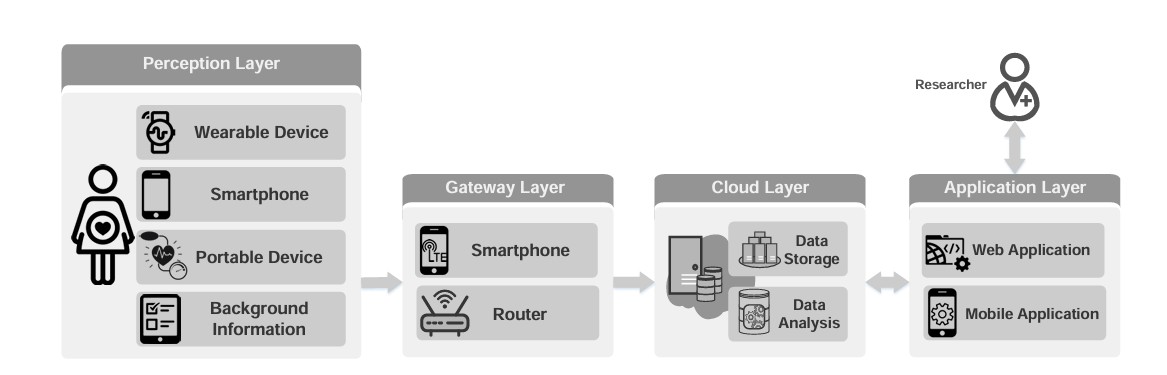
Figure: IoT-based maternal health monitoring system architecture from Sarhaddi et al. (2021).
1. Perception layer
This is the layer where data are collected from the mother. The system uses different devices and sources, such as:
- A smartwatch
- A smartphone application
- A blood pressure device
- Background and demographic information
The smartwatch collects objective data such as heart rate, movement, step count, and photoplethysmography signals. The mobile application collects subjective data through questionnaires and allows users to enter health information such as blood pressure.
2. Gateway layer
The gateway layer sends the collected data from the devices to the cloud. In this system, the gateway can be a smartphone or a WiFi router.
This layer is important because it connects the local devices used by the mother with the remote cloud infrastructure.
3. Cloud layer
The cloud layer stores and analyzes the health data. This is the central part of the application from a cloud computing perspective.
In the article, the cloud server is used to:
- Store large amounts of health data
- Analyze the collected information
- Detect trends and anomalies
- Support personalized health monitoring
- Provide data for visualization
This layer makes the system scalable and useful for remote healthcare monitoring.
4. Application layer
The application layer allows users and researchers to interact with the system. It includes a mobile application and a web dashboard.
Healthcare professionals or researchers can visualize the collected data, observe changes over time, and monitor the mother’s health remotely.
Why is cloud computing useful here?
Cloud computing is useful because the system collects data continuously over a long period of time. Storing and processing all of this information locally on a smartwatch or phone would be limited.
Using the cloud allows the application to:
| Cloud benefit | Why it matters in this application |
|---|---|
| Remote storage | Health data can be saved securely over time |
| Data analysis | Algorithms can analyze trends in sleep, stress, and activity |
| Scalability | The system could support many users |
| Remote access | Healthcare professionals can access the information from different locations |
| Personalization | The system can build individualized models for each mother |
What did the study evaluate?
The researchers implemented the system in a real study with 28 women with high-risk pregnancies. The participants were monitored during pregnancy and for three months postpartum.
The study evaluated several practical aspects of the system:
- Feasibility of long-term use
- Smartwatch wearing time
- Mobile application usage
- Reliability of the collected data
- Energy consumption of the smartwatch
- Possible integration with healthcare systems
The results showed that the system was feasible for long-term monitoring. On average, participants wore the smartwatch for many hours per day during pregnancy, and the mobile application was also used regularly.
Strengths of the application
One of the main strengths of this system is that it combines different types of data. It does not depend only on questionnaires or only on wearable sensors. Instead, it integrates both objective and subjective information.
Another strength is that it was tested in a real-world setting with pregnant women. This makes the study more practical and relevant than a purely theoretical proposal.
The cloud-based architecture is also valuable because it supports continuous monitoring, data storage, and remote visualization.
Limitations and challenges
Although the system is promising, there are some important challenges.
First, wearable devices depend on battery life. If users forget to charge the smartwatch, data may be lost.
Second, health data are very sensitive. Any cloud-based biomedical application must take privacy, security, authentication, and data protection very seriously.
Third, long-term user engagement can be difficult. Pregnant women need to feel that the system is useful and not too demanding.
Finally, integration with real healthcare systems can be complex. For this type of application to be used clinically, it would need to connect properly with existing electronic health record systems and medical workflows.
My opinion
I think this is a strong example of how cloud computing can support biomedical applications. The system is not just storing data; it creates a complete remote monitoring environment that connects patients, devices, cloud infrastructure, and healthcare professionals.
From my point of view, the most interesting part is the combination of IoT devices and cloud-based data analysis. This type of architecture could be useful not only for maternal health, but also for chronic disease monitoring, elderly care, rehabilitation, and preventive medicine.
However, I also think that privacy and clinical validation are essential. A system like this should not replace healthcare professionals, but it could become a powerful tool to support them with more continuous and personalized information.
Conclusion
The cloud-based maternal monitoring system explored in this paper shows how IoT and cloud computing can improve healthcare monitoring during pregnancy and postpartum. By collecting data from wearable devices, smartphones, and medical devices, the system can provide a more complete view of maternal health.
This application is a good example of how digital health technologies can move healthcare from occasional check-ups toward more continuous, personalized, and preventive care.
Reference
Sarhaddi, F., Azimi, I., Labbaf, S., Niela-Vilén, H., Dutt, N., Axelin, A., Liljeberg, P., & Rahmani, A. M. (2021). Long-Term IoT-Based Maternal Monitoring: System Design and Evaluation. Sensors, 21(7), 2281. https://doi.org/10.3390/s21072281